srijeda, 22. listopada 2014.

PANEL: QUALITY AND CREDIBILTY part 2

Marju Himma-Kadakas, University of Tartu, Estonia
Impact of time acceleration on online journalists’ skill performance


Marju Himma-Kadakas elaborate results of her study (interviews and observations of newsrooms) which describe differences between theory and practice about skills needed by Estonian journalists.
Features of modern journalists are:
  • Hypeactivity
  • Multimediality
  • Technological acceleration
Decreasing number of person needed to create information should create opportunity for personal development - be more and more skillful in different aspects of journalism work. In theory journalist should be both content and technology skilled.
Author found that it is not true.  Noways creating content is not as important as researching and linguistic skills that give opportunity to quickly find information translate it and send to audience. Marju Himma-Kadakas think that now in Estonia is no much time for personal development. Skills that are still needed are: 
  • communication in the mother and in foreign language
  • digital competence
  • cultural awareness and expression


dr. Lisbeth Morlandstø and dr. Birgit Røe Mathisen, University of Nordland, Norway
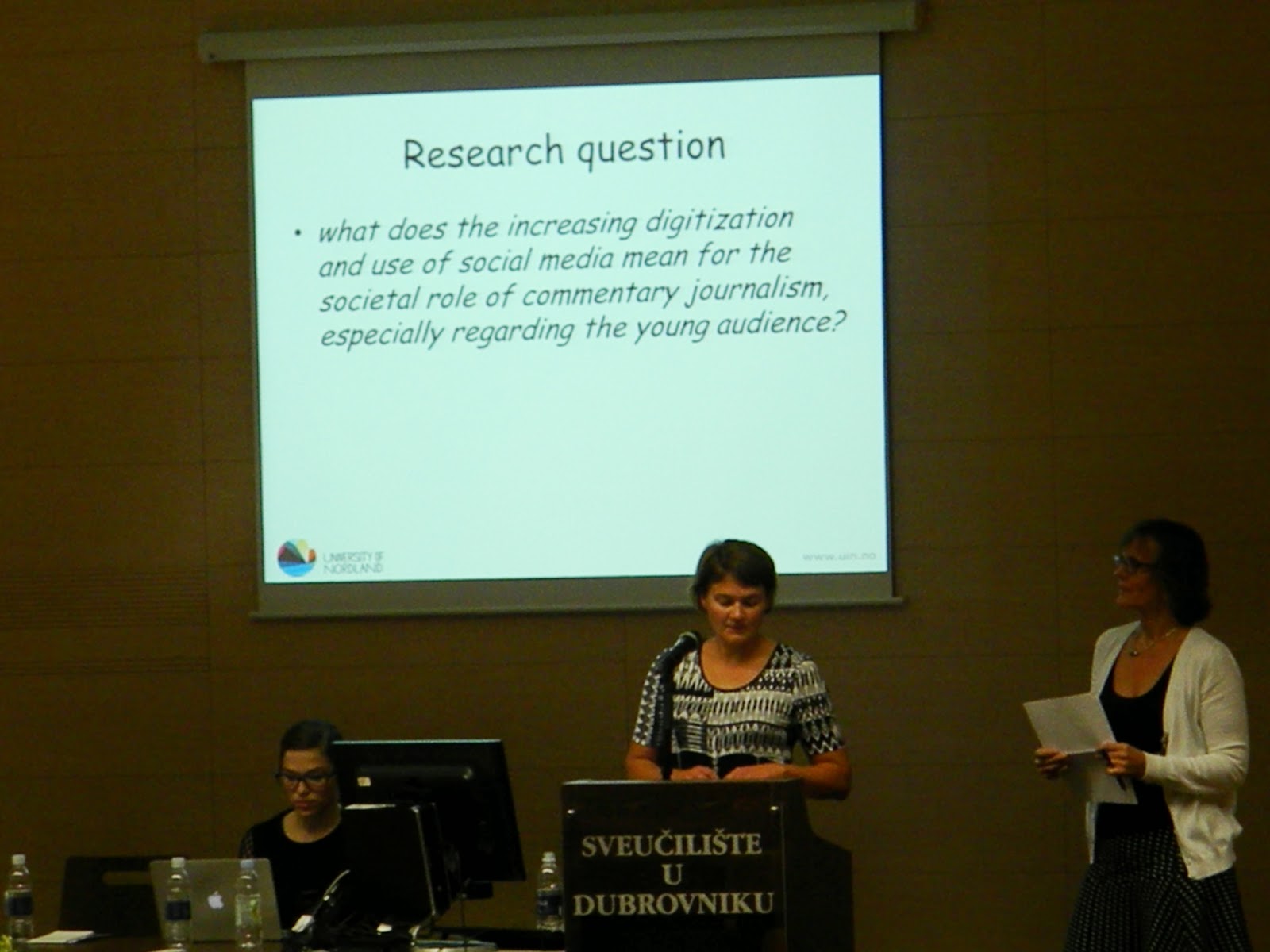
Commentary journalism online – a way to capture the youth?


Dr. Lisbeth Morlandstø and dr. Birgit Røe Mathisen focused on approach of young people to new media and on opportunities that sharing opinion via Internet gives to society. Speakers found that young people are the most active participants on the new digitalized arenas, by producing contents and express their opinion, both in blogs and in digital debates Young people in Norway think that because of online discussions they is more opinions and points of view in public debate – it is possible to hear voice of miniorities or common people.  Digital commentary’s creates more immediate contact and better dialogue with the readers. From that reason it has good influence on democratization process. 
Authors think that important role in this debate should have young professional debate moderators. Future shows does young people want to be and can be good coordinators and if media company also see the importance of their role.


Signe Ivask, Marju Himma-Kadakas, University of Tartu, Estonia
Burnout fostering young reporters to resign journalism


In their speech authors share not only their theoretical knowledge but also experience as journalists.
Topic of burnout is not new but because of today media market in Estonia and technological changes young journalists are especially vulnerable for it. The main reason of burnout are:
  • working all the time under time pressure. Situation when journalists live in stress all the time is especially harmful because they have no support from their coworkers (who also have non stop dead line so have no time for others).
  • Unnatural rhythm of living. Journalists have no time for their private time or for their family, in their free time they are too exhausted or have free time when all other people are working.
In that situation it is no surprise that statistic in Estonia shows there are increasing number of burnout young journalists who  no longer want to work in media system.
Authors think that the only long time solution of this situation is changing the culture of media market  from inside.

PANEL: QUALITY AND CREDIBILTY part 1

In this panel moderated by dr. Inoslav Bešker there were speeches of:


Kay Muehlmann, Danube University in Krems, Austria
Propaganda and Trust: On RESILIENCE in Social Systems a complex adaptive system perspective


Kay Muehlmann see mass media as a part of larger complex social system.

To let the audience understand it he used metaphors from biological world. In complex system parts of the system cooperate without central control (or one group controlling others) to achive more than all of them can do alone (as neurons in brain or ants).

Important aspects of Social System are:
    - Synchronization – structure create social action and vice versa

    - Adaptive cycle - dynamic process that left space for innovations but also is stable


    Three important elements that are most important for good Social System are leadership, social network and trust. In Kay Muehlmann's opinion role of journalism in system is to communicate information, construct of sense of meaning, synchronize social actions and legitimation of roles and actions. Purpose of all this activities should be the benefit of all system. To do it journalists should be ethic and ready to engage and participate in social life. Journalism discourse should be multi-dimensional but also on the same level with audience.


    Sean Dodson, Leeds Beckett University, UK
    Improving online integrity: Towards a code of conduct for journalists on the internet


    In his speech Sean Dodson defended a thesis that all journalism change a lot in case of new media and new technology expect of ethic codes. Sean Dodson analyze about 50 Press Council University codes in Europe. The codes should describe minimal ethic standards to uphold the reputation of journalism. Problem is that codes are often  not updated. For example French code is from 80'. That is one of the reason why codes seem not to notice technological turn, online and multimedia journalism and ethic problems that are connected with that.

    Only a few of codes have mention online journalism problems. 

    Sean Dodson found Dutch code especially interesting in aspect of online journalism. More detail about analyze Dutch code we will manage to read in near future publication. At the end of his speech Sean Dodson showed most important ethic rules which should be in memory of every online journalists.

      And the last rule:
      Conduct yourself on the same level of ethics standards online as in the traditional journalist.


    Fernando Zamith, University of Porto, PortugalMeasuring quality on online journalism: An index proposal


    Fernando Zamith was talking about need of new tool to measure quality of online journalism and compare professional media to citizen media. For first topic Mr. Zamith show the reasons why cyber-journalism should be considered as different than traditional and mention few of the tools that may be useful to measure the quantity.
    For second part he describe his study showing that professional journalism is still more important (most common part of citizen activity is intervention: sharing and liking). He found that professional media are still more reliable than citizen.


    subota, 18. listopada 2014.

    Panel 2: Current state and the transformation of audience

    Saturday morning at Dubrovnik media days was dedicated to broad scale of speakers from mostly balkanic countries, including Croatia and Albania, but also Bulgaria, Sweden, Slovakia and Turkey.
    Panel 2 was opened by presentation from dr.Inoslav Besker, profesor at University of Bologna,Italy and University of Dubrovnik, Croatia. Mr.Bešker was sharing his research about crisis of the newspapers’ business model, focused on the case of Croatia.
    Followed by croatian journalist Iva Nenadič from University of Osijek who talked about content analysis and online editions output in croatian newspapers.
    Both PR professionals and journalists from University of Osijek,Croatia, Francesca Vlašić and Sandra Brautović presented their research with question whether there’s a symbiosis or conflict between these two profesions. Since both of these ladies work in both of those profesions, their result comes from first hand – both the PR professionals and the journalist realize that there’s a certain conflict in their profesions, but that there’s also a huge space for the opportunity to benefit from their differences.
    Dr.Mark Marku from Tirana University in Albania talked about how social media changes public opinion and is challenging the traditional system of news making.
    Britt-Marie Ringfjord from Linneaus University in Sweden shared her study about How media frame innovation and gender. Mrs.Ringfjord is currently guest teacher at University of Dubrovnik in Croatia as well.
    Dr.Rastislav Kazanský from Matej Bel University in Banska Bystrica, Slovakia shared his recent study about the role of media in diplomacy concept. He pointed out very clearly that media is for great use in the world of diplomacy and has power to help to solve certain problems.
    All the speakers shared their studies about current state of journalism and its impact on the audience.
    To sum it up, it is clear that journalism is facing changes due to the growth of online media, but these changes are for sure beneficial for the future of journalism.


    University Of Dubrovnik Conference

    UNIVERSITY OF DUBROVNIK CONFERENCE: THE FUTURE OF JOURNALISM


    The future of journalism is changing due to the arrival of the New Media Technologies. This is the mainly topic of the conference.
    First, we are introducing the principal speakers today.

    -dr. Piet Bakke: teacher of mass Communications and journalism Studies from Netherlands. His proffesional career includes workshops in several magazines, newspapers and radui stations.
    Speach: New Complexities in Digital Journalism: commercial challenges, technical skills & personal branding


    -dr. Marko Milosavljevič: head of department of journalism at faculty of social sciences at university of Ljubljana, Slovenia.
    He is a member of different national and international committees,
    Speach: Digital Journalism in 3D - Disruption, Deprofessionalisation, Dehumanization


    -Nataša Ban Palunčić, M.A.: professor of Sociology associate at University of Dubrovnik, PhD Candidate on Communication Sci, Mass Media and Public Relations.
    Speach: Citizen journalism: A future fair reporting of socially disadvantaged minorities such as the homeless.

    -dr. Tena Perišin: She  teaches television journalism at the Journalism Program at the Faculty of Political Sciences in Zagreb. Furthemore, She is a member of the EBU News Committee and a member of the EBU File Transfer group. She is also active member of the EBU News Assembly.
    Speach: Future of Journalist: Digital skills in search for 5W and H


    -dr. Dorde Obradović: head of the international science journal MEDIANALI and leader "of the Media Research Center," Department of Communication at the University of Dubrovnik. He works as a professor in the University of Dubrovnik in the Mass Communication Department.
    Speach: The future of journalism between news aggregators and PR(opaganda)

                                                                 
    -dr. Domagoj Bebić: senior Research Scientist at Google, Inc. His researches are related to verification, testing, synthesis and security on software systems, automated reasoning, grammatical inference and applied formal methods in general.
    Speach: Viral journalism: the rise of the new form

    -Jaana Hujanen: She works at Swedish School of Social Science. Her last activity was “Assessment of candidates for professorhip in communication”.
    Speach: Reinventing the relationship between journalists and audience: The case of Finnish news media.

    To continue, we are going to sum up the different lectures.

    New Complexities in Digital Journalism: commercial challenges, technical skills & personal branding.
    The digitalization has changed society and media, so, as consequence of this, Journalism has changed as well.
    The future of journalism is on the Internet.
    Advertising is more profitable in New Media than in old methods. How does it affect to journalism career? As he said, if New Media grows up, journalism will be affected negatively. In this context the bloggers appear, being more popular than real journalist. It makes that everyone believe that they can be a professional journalist and think that they can find news for free everywhere. It´s a mistake.
    On the other hand, in the newsroom, there are not as much professional as it uses to have. Nowadays, there are a lot of freelancers. Therefore, the workers are multitasked people. As consequence, they have more autonomy participation and resources, so they are more efficient and they are able to create content.
    The aim is not to protect newspaper but to do it more important.
    Today, the professionals use new technologies as smartphones instead of the tradicional tools.
    As conclusion, if you want to work in this career you have several options like freelance, trainer and social media.


    Digital Journalism in 3D - Disruption, Deprofessionalisation, Dehumanization


    New media ecosystem is more dinamic and changes quite fast
    People want fresh ideas, it doesn’t have to come from professionl journalists, so it means that this information doesn’t have to come from a newsletter, although that actually comes from there. So, bring punk to journalism!
    As he claims,technologie is not the enemy, it is a big help.
    Disruption.
    The difference between Internet 2.0 and Internet 3.0 is that last one is Internet of things where you can create your own content.
    Deporfessionalisation
    People want creators, people who makes differently and much better. That’s why there are so many famous people who becomes a source of news and they are not actually journalists.
    Dehumanization
    Machines or humans? We would study this answer with advantages and disadvantages, so as he said it needs regulations as soon as possible. This is very difficult because it changes so fast.
    As consequence of the text mentioned before, technologie is rising and it is making that there are fewer proffesionals working in this career.
    For instance, the most profitable companies are those ones that use more machines. However, they don’t produce content.
    Discusion:  Is there any future for journalists? Will people want to study that? We have to make students flexible, entepreuners. You have to be able to fight for yourself, you have to be creative. But how do you teach creativity? I feel like the biggest chalanges are here for schools, nof for the students themselves.


    Citizen journalism: A future fair reporting of socially disadvantaged minorities such as the homeless.

    In Croatia, there are over 20.000 homeless. Before coming to the U.E it wasn’t a specific regulation, but now they have to include the social welfare at.
    The objective is to know what attitudes the media has about homelessand what is the incidence in them.
    Hypothesis:
    -Citizen journalism is available to everyone.
    -Citizen journalism deals with topics that public journalism bypasse.
    -Citizen journalism is dealing with minorities.
    -Homelessness is topic which we most learned from the public media.
    -The men movement and socially concious permisssible actiones come from the public media.


    Future of Journalist: Digital skills in search for 5W and H

    Nowadays the media companies are becoming new model of business. That can means that the quality of news can be corrupted. Newespaper is more worried about business than good information.
    Television can show us news and make them appear more visible. Therefore if something appears in TV it happens for people, if not it does not happen.
    Breaking news or black hole? Sometimes you do not know about the quality of information, and you can be missinformated.
    To conclude it is necessary to suggest the audience and give more content than contexts.


    The future of journalism between news aggregators and PR(opaganda)
    A public relations is a person who speaks with public companies, so he is between both. It is like a connector.
    News agregator: He helps to give more importance and to improve.
    News editor: He does not  care about good news, just produce it.
    On the other hand, most of  news on the Internet are propaganda instead of journalism, it decreases. Even, we do not distinguish between them.
    Framing. It is the most important tool, you can not avoid it. It is like a dicctionay of handling.
    Guidance. It is a tool to keep journalists in the frame.
    The future of the journalism is the propaganda.


    Viral journalism: the rise of the new form

    There are some many changes in technical things but also in communication. The creation of contents and distribution has been changed too.
    Brands have become created of content, but, in the other hand, people who are creators of contents must do branding to themselves.
    Creating content is a hard task because you do not know which way to do it is the best. Also, in tradicional media is important because it involves everybody. But this content has to be shared.
    Is it necessary a new regulation for the journalism? Yes, it is. A new ethic in journalism is necessary because of the changes in media ecosystem.
    Furthermore, journalism should be more interactive and not just informative. In this way, the news become viral due to they can be shared and allow to participate.


    četvrtak, 24. listopada 2013.

    Student panel; new media tools

    During Dubrovnik media days there was also a student panel which were represented by mr.sc Andrea Bender and  mr.sc. Roman John. They spoke about the new media, especially about making many errors in creating and using some websites. Actually, they presented their graduate studies; Romana John spoke about potentials of advertising agencies while Andrea Bender made a research on communication to the public of Croatian universities.


    Speakers explained how to use knowingly possibilities of new media and gave many practical tips. Andrea Bender and Roman John pointed out that if you are not in the Facebook, you do not exist also in the real world. Nowadays, Internet is a place where you  buy, sell, advertise and also introduce yourself for potencial employers, so it is really an essential modern tool in the process of communication. They also claimed that is really surprising how many people do not acquire knowledge of using new media, as for example creating unclear and too poor websites in only their own mother tongue, which was  really a big mistake as should be also translated into global language, like English.


    Moreover, Blog, Twitter and Facebook are the most important new media which should be properly used, but a lot of people still have problem with do this, so I think it was a really good  idea that Andrea Bender and Roman John explained the audience how to be more aware users of these media.


    To conclude, Blog, Twitter and Facebook are the most important new media which should be properly used, but a lot of people still have problem with do this, so I think it was a really good  idea that Andrea Bender and Roman John explained the audience how to be more aware users of these media.


    srijeda, 23. listopada 2013.

    Odnosi s javnostima u Vladi : Manipulacija ili potreba?

    Konferencija je zaključena okruglim stolom na kojem su sudjelovali prof. Anne Gregory, mr.sc. Aleksandra Kolarić iz Hrvatske udruge za odnose s javnostima ( HUOJ) te prof.. Marko Milosavljević, a raspravljali su o potrebi službe za odnose s javnostima u uredima Vlade. U ulozi moderatora našli su se studenti Odjela za komunikologiju, Ivica Ljubas te Gloria Mage.


    Raspravu je otvorila Anne Gregory rekavši kako su u Velikoj Britaniji postoje dvije grupe PR eksperta u Vladi. Postoje javni službenici od kojih neki desetljećima rade za Vladu stoga je njihova uloga prepoznata kao izuzetno važna. Uloga im je objasniti postupke Vlade, ali ni u kojem slučaju ne smiju širiti propagandu. Druga skupina su takozvani "spin doktori" koji su politički angažirani i zastupaju interese vladajuće elite. Zakonom im je dopuštena pristranost i subjektivnost, te propagiranje stranke.

    Potom je Aleksandra Kolarić stanje u Hrvatskoj nazvala kaotičnim : Who does what, how and why? Trenutačno je u Hrvatskoj u ulozi glasnogovornika osoba koja je istovremeno stranački i javni službenik što hoće reći da je stanje nesređeno i nedovoljno regulirano.  Ona zapravo ne odlučuje o komunikacijskim potezima već je za to zadužena savjetnica pri uredu Vlade koja je samo prividno volontira, a zapravo je angažirana kao konzultant od strane PR agencije koja je zadužena za Vladu Republike Hrvatske. U tom pogledu, oglasila se i Hrvatska udruge za odnose s javnostima čije Vijeće časti je taj slučaj proglasilo sukobom interesa. Reakcija Vlade bila je suprotna očekivanjima;  ukidanje službi za odnose s javnostima u svim tijelima državne uprave.

    Profesor Marko Milosavljević na pitanje je li činjenica da većinu političkih članaka zapravo pišu PR-ovci manipulacija sadržajem ili potreba, obzirom da broj novinara specijaliziranih za politiku manjka, kaže kako je takav  pristup uvriježen u europskim zemljama, poput Velike Britanije.Za zemlje u regiji nije potpuno siguran, ali također smatra da je situacija slična. Još uvijek je jako puno takozvanog copy-paste novinarstva koje se bazira nanovinarskim priopćenjima. Osim u politici, događa se i da su stručnjaci određenog područja, primjerice ekonomije i  sporta,  autori  novinskih napisa. Takva praksa povećava produktivnost u smislu količine sadržaja, ali ne i kvalitete. Postavlja se pitanje koliko dodatne vrijednosti se na taj način dobija. Tako specijalizirani ljudi ne poznaju pravila novinarske struke i ne znaju na odgovarajući način prenijeti informaciju. Zato su novinari još uvijek nezamjenjivi.


    Ukorak s razvojem; korak do propasti

    Ključan govornik drugog panela bio je doc. dr. sc. MarkoMilosavljević , profesor s Fakulteta društvenih znanosti  u Ljubljani koji je održao predavanje na temu  Mediji u ekonomskoj krizi“.  Naglasio je da mediji ne izvještavaju samo o krizi već su u potpunosti njome zahvaćeni.  Osim očitog ekonomskog aspekta krize,  globalni mediji proživljavaju i tehnološke poteškoće koje utječu na kvalitetu izvještavanja  stoga Milosavljević ističe kako su novinari prisiljeni ići ukorak s ubrzanim razvojem tehnologije . 

    Broj novinara se neprestano povećava dok uvjeti rada postaju sve teži. Posao novinara danas podrazumijeva nepovoljne uvjete  kao što su neutvrđeno radno vrijeme i neprestano praćenje zbivanja na lokalnoj i svjetskoj razini. Slobodno vrijeme ne postoji za uspješnog novinara, javnost ne može čekati. Osim navedenih problema, novinar mora biti pripremljen za „multitasking“, odnosno sposoban izvoditi mnogobrojne aktivnosti u isto vrijeme. Na taj način gubi se usredotočenost na pojedinačne zadatke kao i njihova vrijednost.
     Ubrzan tempo zbivanja ne ostavlja novinarima vrijeme  za analiziranje činjenica.  Istraživačko novinarstvo je djelatnost koja izumire

    Milosavljević ističe kako je za takvu vrstu novinarstva potrebno vrijeme i novac, a to je upravo ono što si mediji ne mogu priuštiti. Nemogućnost provjere informacija odrazila se na vjerodostojnost medijskog sadržaja.  Zapošljavanje  stručnjaka sa područja ekonomije, prava ili sporta postalo je praksom . Stoga uz sve probleme kojim su opterećeni novinari postoji i stalni pritisak gubitka posla.

    U drugom dijelu izlaganja, Milosavljević se usredotočio na krizu medija u regiji  gdje su svi navedeni problemi posebno izraženi, a tiču se ograničenosti tržišta i mogućnosti .O ograničenosti potencijala možda najbolje govori činjenica kako: „More people ride New York's city buses everyday then live in Slovenia“ ( U New Yorku se više ljudi vozi u autobusima nego što Slovenija ima stanovnika.“)
    Novinarstvo kakvo imamo ovdje ne može se mjeriti sa snagom vodećih europskih i svjetskih medija stoga ga javnost zanemaruje. Često u ovim ograničenim mogućnostima novinari nemaju opciju pridržavati se poslovnih normi nego raditi sve u svojoj moći da bi opstali. Takvi neetični postupci rezultiraju gubitkom vjerodostojnosti što povećava mogućnost da mediji neće doživjeti završetak krize.

    „Šizofrenija na tržištu - zakoni u fioci“

    Profesorica Dubravka Valić Nedeljković sa Sveučilišta u Novom Sadu progovorila je o stanju srpsikh medija u kontekstu ekonomske samoodrživosti. Navela je neke od najvažnijih problema koji koče medijski napredak u nama susjednoj zemlji.  Kako se u današnjem kapitalističkom društvu sve vrti oko novca tako je on presudan faktor i u svijetu medija. U Srbiji je vlasnička struktura istih netransparentna;  često iza njih stoje tajkuni koji osim što utječu na medije imaju snažan utjecaj i na vladajuću elitu. No, upravo je ta ista vladajuća elita jedna od najvećih marketinških agencija u zemlji čiji udio u oglašavanju iznosi oko tri četvrtine reklamnog prostora.  Stoga ne iznenađuje činjenica da brojni zakoni ostaju „u ministrovoj fioci“  u korist vlasnika medija.
    Iz svega ovoga proizlazi neuređeno odnosno „šizofreno“ tržište, kako ga je opisala Valić Nedeljković  gdje postoji više od stotinu piratskih radio i TV postaja. Javni medijski servis je na rubu bankrota. Novinarske plaće iznose dvjestotinjak eura, a čak osam od dvanaest izdavača dnevnih novina posluje u gubitku!!

    Najreprezentativniji primjer ovog nereda koji vlada na medijskoj sceni Srbije je RTV Vojvodina.
    „Upravni odbor ove televizijske kuće objavio je da će „ugasiti struju“ zbog velikih financijskih gubitaka koji su uzrokovani šokantnom  izjavom prvog potpredsjednika srbijanske Vlade, Aleksandra Vučića, koja je usput i nelegalna. “
    Na svom Twitter profilu objavio je da se pretplata na televiziju ionako ukida pa da je građani sukladno tome ne trebaju ni plaćati. Izjava je izazvala medijsku „buru“ , a građani su (naravno) pretplatu prestali plaćati.

    Ova profesorica sa trideset godina novinarskog iskustva moguća rješenja vidi u osnivanju nezavisnog fonda za financiranje javnog medijskog servisa, racionalizaciji troškova te digitalizaciji Srbije koja bi se trebala provesti 2015.  Time bi zakoni, umjesto da budu u fioci, obuzdali tržišnu šizofreniju.

    nedjelja, 20. listopada 2013.

    Kritički aspekti medijske krize u Grčkoj

    Sljedeći je  izlagao dr. sc. Yiannis Mylonas sa švedskog Lund sveučilišta koji je na primjeru grčkih mainstream medija progovorio o krizi u političkom i kulturalnom kontekstu. Navodi kako se bavi istraživanjem krize ne samo na primjeru Grčke već i Skandinavije iako kriza na sjeveru nije toliko izražena kao na jugu Europe te posebno izdvaja tendencije jačanje ekstremne desnice u političkom kontekstu potonjih. (Izlaganje o Skandinaviji )

    Nadalje, smatra kako je globalna kriza zapravo  kriza neoliberalizma .U zadnje tri godine država se nije maknula s početne pozicije u rješavanju krize. Kako postoji spektakularizacija i tabloidizacija medija tako se istovremeno i krizu prikazuje na senzacionalistički način što je naročito prisutno u tabloidima s pitanjima poput  "Kada će nastupiti kolaps?" čime se samo potencira i ionako ozbiljno stanje.Kriza u Grčkoj je prema Mylonasu  moralno i  kulturalno koncipirana jer smatra kako su pretjerana rastrošnost i  život iznad mogućnosti fundamentalno doveli do ovakvog stanja.

    Osim toga, kaže kako je još uvijek teško nadvladati svojevrsni stereotip "lijenog Grka"  kojeg na neki način stvaraju i kataliziraju i turisti iako prema istraživanjima ekonomista  prosječan reporter u Grčkoj radi duže nego u ostalim europskim zemaljama.

    Analizu sadržaja proveo je na primjeru grčkog lista Ekathemerini, koji izlazi od 1990. ,a  u vlasništvu je utjecajne grčke obitelji Allafousus, svojevrsnih medijskih mogula na primjeru Grčke.   Pitanja koja je postavio bila su " Što javnost zna o krizi, kako dobija te informacije i kako su one uokvirene?" te " Može li javna sfera išta promijeniti po pitanju krize?" Mylonas je proveo istraživanje u dvije etape, a protezalo se kroz četiri godine s početkom u rujnu 2009. počevši od rastuće krize, nepovjerenja u mogućnost vraćanja zajmova i masovne proteste uzrokovane nesređenim, gotovo kaotičnim stanjem pa do uspostave nove Vlade. Zaključci su kako je svatko u državi odgovoran za krizu, ne samo Vlade, biznismeni i velike korporacije već je odgovornost na svakom pojedincu. U društvu nema dovoljno kritičkog mišljenja niti dovoljno informacija za stvaranje mišljenja te se naglašavaju odabrani primjeri da bi se potvrdile određene pretpostavke, problem je u kontekstualizaciji.


     " The individualists are to blame really, it is a so called culture of anomy." 
     (Treba kriviti pojedince jer tako se stvara društvena anomija.)


    Next speaker was dr. sc. Yiannis Mylonas from the Swedish Lund University. He discussed the Greek mainstream media which presented the readers only the news about crisis lacking critical  point of view. Yiannis Mylonas highlighted that the crisis was not only visible in Greece, but also in the north part of Europe, Scandinavia,  even if it was not so visible like in the southern Europe.

    According to Yiannis Mylonas, it was caused by some orthodoxed right-wing political party which was strengthening the power in the southern Europe. What is more, scientists claimed that the global crisis was actually a crisis of neoliberalism and nothing more. Furthermore, during the last three years, the state did completely nothing to resolve this problem even if it had some eligible initial solutions for such serious crisis. Unfortunately, this media crisis was also visible framed in some tabloids with questions like "When will come the collapse?” which made this situation more dramatic, serious and spectacular for every citizen around the world.


    He considers that the media highlighted that the crisis in Greece was caused by the Greek’s excessive extravagance lifestyle. In addition, crisis was shown in many international mass media which also created a new stereotype of the “lazy Greek”. Moreover, speaker made an analyse of the content of Greek’s Ekathemerini newspapers owned by the influential Greek families Allafousus who were well-known as peculiar media moguls in Greece.

    The main questions during this speech were “What the public knows about the crisis and how mass media frame some information for public audience?" and "Is any possibility that the public sphere will be able to change anything to defeat this crisis?”. What is the most interesting in this press is the fact that a case study was divided into two phases and lasted four years (it started on September 2009 when one could have easily observed the growing crisis with many chaotically riots which and finally in establishment of the new government). To sum up, everyone was responsible for the crisis and not only the government, businessmen and large corporations as many people thought. Public opinion should remember that not only companies critical thinking and enough information about the economic situation in the state, but almost every citizen should observe the domestic market. The conclusion is that the crisis should be addressed to individuals because it is perceived as a crisis of an individual person, members of the society, a moral and cultural crisis where a so called culture of anomy is created. 

    subota, 19. listopada 2013.

    Krivci za financijsku krizu: ekonomisti ili PR-ovci?

    Prof. dr.hab. Ryszard Lawniczak sa Vojno - tehnološkog sveučilišta iz Varšave započeo je izlaganje anegdotom sa skupa ekonomista na kojeg je bio pozvan prije nekoliko godina kada je izlagao slično predavanje kao i za Medijske dane. Jedna grupica ekonomista entuzijastično je prihvatila njegove riječi. Ta ga je reakcija začudila, ali i zabrinula, te ih je pitao za objašnjenje na što su mu rekli da im je laknulo te da im je „otvorio oči“ svojim govorom jer krivci za krizu zapravo i nisu ekonomisti već PR stručnjaci.  Potom je znakovito pogledao stručnjakinju za odnose s javnostima Anne Gregory. Izlaganje se nastavilo u malo ozbiljnijem i činjeničnijem tonu. 

    Budući da i studenti sa ERASMUS programa razmjene također sudjeluju u objavama koje se tiču konferencije s medijskih dana, studentice iz Poljske, Aleksandra i Alice, dobile su zadatak izvijestiti o čemu je pričao njihov sunarodnjak.


    Professor Ryszard Lawniczak from Military University of Technology in Warsaw, Poland spoke about PR`s contribution to the global financial and economic crisis. During his speech, he tried to explain the main reasons of economic crisis as well as to persuade that not only economists are responsible for this situation, but also people who work in PR agencies. The main question of the speech was not only: who is responsible for present crisis and the collapse in 2008/2009, but also: what is exactly the role of a public relation specialists in the image repair campaign of business and mainstream economic theory. According to Ryszard Lawniczak, „world financial crisis reveals a lot of false, or idealistic assumption in the PR“ and the main issues are: managerial greed and social irresponsibility. He also mentioned some American orthodox ideology which was concentrated on TINA ideology - „There is no alternative“ as well as some statement like „ What is good for Wall Street, is good for America“. Moreover, Ryszard Lawniczak also said something about some „facial saving“ campaigns for neoliberalism theory, which is now completely overabused by PR` agencies.

    He concluded with a sentence that „Public relations industry has contributed to and may be held partly responsible for the 2008/2009 financial crisis and the recent collapse“ and added that his colleagues, the economists, were not absolutely right putting the blame on the PR people.

    Profesor Ryszard Lawniczak sa Vojno - tehnološkog sveučilišta u Varšavi govorio je o doprinosu službe odnosa s javnostima i utjecaju na globalnu financijsku odnosno ekonomsku krizu, kako je naveo i u naslovnom slajdu svog izlaganja. U svom govoru nastojao je objasniti glavne razloge / uzroke ekonomske krize kao i uvjeriti nazočne da nisu samo ekonomisti odgovorni za aktualnu situaciju i već i zaposlenici PR agencija. Pitanje nije bilo samo tko je odgovoran za aktualnu krizu i kolaps 2008. / 2009.  već i koja je uloga stručnjaka odnosa s javnostima u popravljanju imidža i mainstream ekonoske teorije. Prema Ryszardu Lawniczaku „...svjetska financijska kriza otkriva velik broj lažnih, idealističkih pretpostavki u PR-u“  te su ključni problemi menadžerska pohlepa i neodgovornost prema društvu.

    Također je spomenuo američku ortodoksnu, krutu ideologiju koja se fokusirala na TINA ideologiji što je kratica za „There is no alternative“  - Nema alternative te izjavu kako je ono što je dobro za Wall street istovremeno dobro i za Ameriku. Nadalje, Lawniczak je govorio kako PR agencije sada kompletno zloupotrebljavaju  kampanje za spašavanje imidža iz teorije neoliberalizma.

    Zaključio je izlaganje tezom kako je industrija odnosa s javnostima  (PR industrija) doprinijela i može se smatrati djelomično odgovornom za financijsku krizu te kolaps  iz 2008 / 2009.  Stoga njegovi kolege, ekonomisti sa početka izlaganja, nisu bili u potpunosti u pravu kad su svalili krivnju na ljude iz PR industrije.